 Sebring Mobile Home Leveling
 Mobile Home Tie-Downs & Anchors in Sebring, FL
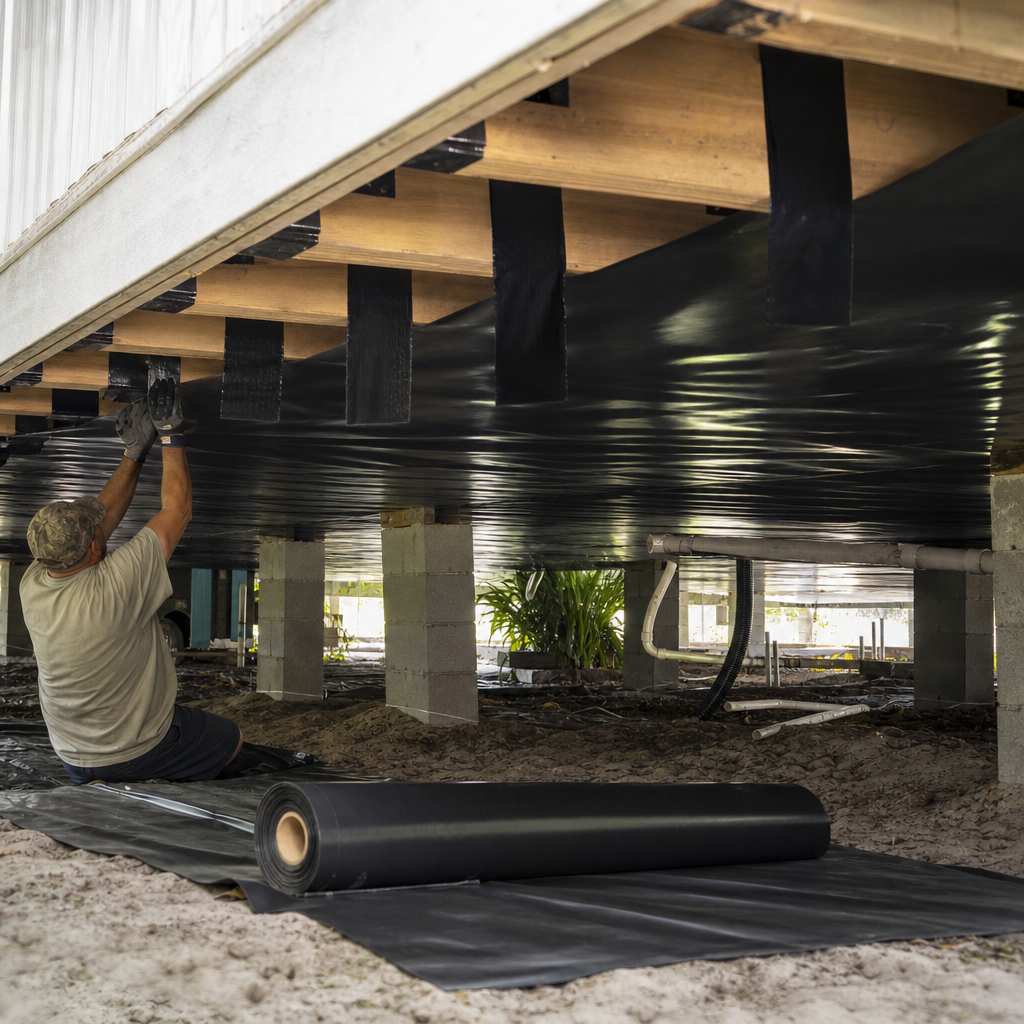
Tie-downs and anchors are the only thing holding a manufactured home to the ground in a hurricane. The system is simple: steel ground anchors screwed into the soil, galvanized straps running from the anchors to the frame, stabilizer plates that keep the anchor heads from plowing sideways, and on newer installs longitudinal ties that resist wind along the length of the home. Anchor installs, retrofits, strap replacement, and re-tensioning across Sebring and Highlands County are our work, done to Florida Rule 15C-1 and HUD Wind Zone II. A full install or retrofit runs $600 to $3,500; strap re-tensioning should come with every relevel.
Highlands County has had a hurricane’s center on or beside it three times since 2004. The anchors are not theoretical here.
The rules that apply in Sebring
Wind Zone II. The federal standard at 24 CFR 3280.305 designs Zone II homes against a 100 mph wind and Zone III against 110. Florida’s Zone III counties are listed by name, Broward, Charlotte, Collier, Dade, Franklin, Gulf, Hendry, Lee, Martin, Manatee, Monroe, Palm Beach, Pinellas, and Sarasota, and every other Florida county is Zone II. That puts Highlands, Polk, and Hardee in Zone II. Highlands County’s used-home pre-move standards require the data plate to “indicate compliance with Wind Zone II and Climatic Zone I requirements,” so a Zone I home built for somewhere else is not going to get a setup permit here.
Florida Rule 15C-1.0104. This is the anchoring standard, and it is specific:
- Diagonal tie-downs “in all wind zones, shall be spaced no farther apart than five feet four inches (5’4”) on center with anchors placed within two feet (2’) of each end.”
- Longitudinal tie-downs are required in addition to the sidewall and marriage-wall systems, with “at least four (4) anchors and straps” at the end of each section, “i.e., 16 per double-wide home.”
- Anchors come in two classes. Type I, “for homes manufactured before July 13, 1994, shall be tested to a working load of three thousand one hundred and fifty (3,150) pounds.” Type II, for homes built after that date, “shall be tested to a working load of four thousand (4,000) pounds.”
- Frame ties use a factory-fabricated strap connected at the top of the I-beam to a department-approved beam clamp.
Highlands County’s permit worksheet. For a setup, the county requires a torque probe test of the soil, and “a test showing 275 inch pounds or less will require 5 foot anchors.” Lateral arm systems, which some installers use in place of separate diagonal ties, “cannot be used on any home (new or used) where the sidewall ties exceed 5 ft 4 in.” The pocket penetrometer test that sets pier spacing is done at the same visit. “ALL TESTS MUST BE PERFORMED BY A LICENSED INSTALLER.”
What three hurricanes did here
Charley, August 13, 2004. A Category 4 at landfall near Cayo Costa with 130-knot winds, and still a hurricane when it “moved through Fort Ogden, Arcadia, Zolfo Springs, and Wauchula” and past Lake Wales at 7:45 PM, according to the National Weather Service Tampa Bay summary. The NWS notes that “several manufactured home, mobile home, and RV communities were heavily damaged or destroyed between Arcadia and Wauchula.” Wauchula, 35 miles west of Sebring, saw 85 percent of its buildings damaged or destroyed. Highlands County was on the east edge of the wind field: a radio tower near Sebring came down, homes near Avon Park were damaged, and the Archbold station south of Lake Placid gusted to 49 knots.
Irma, September 10 to 11, 2017. Ashore at Marco Island as a Category 3, up through Hardee and Polk overnight as a Category 2 fading to a Category 1, with a wind field that spread tropical-storm-force winds 360 nautical miles from the center. The Sebring FAWN station logged a 49-knot reading at 0300 UTC on the 11th, and rain gauges caught 10.54 inches at Sebring 4.7 WNW and 9.42 at Avon Park.
Ian, September 28 to 29, 2022. The direct hit. The National Hurricane Center best track has Ian’s center at 27.2N 81.7W with 100-knot winds at 0000 UTC on the 29th and at 27.7N 81.1W with 65-knot winds six hours later. Draw the line between those points and it crosses Highlands County through Sebring. Sebring Regional Airport gusted to 78 mph, about 89 percent of the county lost power, Wauchula gusted to 81, and a brief tornado touched down in Lake Placid.
Three storms, three different tracks, and in every one the manufactured homes that failed were the ones whose anchoring had quietly stopped being an anchoring system.
How anchoring fails without a storm
Settling loosens straps. Every time a pier drops a half inch, the strap running over that section of frame goes that much slacker. On Lake Wales Ridge sand, where piers settle continuously, straps that were tight at setup are loose within a couple of years. A slack strap lets the home move before it loads, and a home that moves in a gust is a home that racks. This is why straps should be re-tensioned as part of every relevel, and why leveling and tie-downs are best treated as one job.
Anchors corrode below grade. The shaft of an anchor lives in wet sand or, on the flatwoods side of the county, in ground that is saturated for months. Corrosion happens where nobody sees it. FLHSMV’s own guidance tells owners to “replace straps or ground anchors that show signs of corrosion or damage.”
Older homes were anchored to the old rule. A large share of the park stock around Sebring, Avon Park, and Lake Placid predates July 13, 1994. Those homes were built before HUD’s post-Andrew wind standard and were typically anchored with fewer ties, at wider spacing, to Type I anchors. Many have never had longitudinal ties at all.
Stabilizer plates are missing. Without a plate, the anchor head plows sideways through sand under load. FLHSMV lists “ground anchors and stabilizer plates have been installed properly” as a specific inspection item.
What the tie-down inspection checks
The free survey that starts every job includes the anchoring. Our crew works through the same items FLHSMV publishes: loose straps, straps “properly aligned and not on an angle,” the correct number of tie-downs for the home’s length, anchors and stabilizer plates in place, “support piers in contact with the frame,” and corrosion on any strap or anchor. They count what is there against the 15C-1 spacing for the home’s length and note the anchor type against the home’s build date. You get a written count and a quote that separates re-tensioning from replacement from retrofit.
Pricing
| Work | Range |
|---|---|
| Strap re-tensioning during a relevel | Included |
| Replace corroded straps or anchor heads | Quoted per anchor |
| Add stabilizer plates or longitudinal ties | Quoted per anchor |
| Full install or Zone II retrofit | $600 to $3,500 |
Anchor count drives the price. A short singlewide that needs a handful of replacements is the bottom of the range. A 70-foot doublewide on a pre-1994 anchor system that needs full diagonal spacing, 16 longitudinal anchors, and five-foot anchors because the torque test came in under 275 inch-pounds is the top. The pricing page lays it out beside the other rates.
Timing
Anchor demand spikes twice: at the start of June when hurricane season opens and the 55+ parks have emptied for the summer, and in the weeks after a named storm. The better time is March or April, when the ground is at its driest, the snowbird owner is still in town to sign, and no one is in line. If you are selling, the pre-sale inspection covers the anchoring as part of its report. If the home is being moved, the new anchor system is part of the setup and gets counted from the county’s soil tests.
Section 320.8249 requires a licensed installer for anchor work, so ask for the license number and check it with FLHSMV before the first anchor goes in. Request the free inspection and find out what is actually holding your home down.
Frequently Asked Questions
How much do tie-downs cost in Highlands County?
A full anchor system install or retrofit runs $600 to $3,500 depending on how many anchors the home needs, which is driven by its length, the Wind Zone II tie spacing, and whether soil tests force five-foot anchors. Replacing a few corroded straps or anchor heads is quoted per anchor, and strap re-tensioning is included with every relevel.
What wind zone is Sebring in?
HUD Wind Zone II, designed against 100 mph. The federal standard at 24 CFR 3280.305 lists Florida's Zone III counties by name, coastal counties such as Charlotte, Lee, Sarasota, and Manatee, and puts every other county, including Highlands, Polk, and Hardee, in Zone II. Highlands County's own used-home standards require the data plate to show Wind Zone II compliance.
How many anchors does my home need?
Florida Rule 15C-1.0104 spaces diagonal ties no more than five feet four inches on center with an anchor within two feet of each end, and adds at least four longitudinal anchors per section end. A 60-foot singlewide needs a dozen or more diagonal ties per side before the longitudinal ones; a long doublewide can pass twenty anchors in total. The survey counts what is there and what the rule calls for.
My home was built in 1985. Do the old anchors count?
They may not. Rule 15C-1.0104 sets Type I anchors, tested to a 3,150-pound working load, for homes manufactured before July 13, 1994, and Type II at 4,000 pounds for later homes. An older home is also likely to have fewer ties than current spacing calls for, corroded shafts below grade, and straps that went slack every time the home settled. A free tie-down inspection tells you exactly where it stands.
Does Highlands County require a soil test for anchors?
For a setup permit, yes. The county's mobile home permit worksheet requires a torque probe test, and a reading of 275 inch-pounds or less requires five-foot anchors instead of four-foot. The worksheet also notes that lateral arm systems cannot be used where sidewall ties exceed five feet four inches, and that all tests must be performed by a licensed installer.
More mobilehome services
- Mobile Home Leveling in Sebring, FL
- Mobile Home Pier & Pad Repair in Sebring, FL
- Mobile Home Vapor Barrier Replacement in Sebring, FL
- Mobile Home Skirting Repair in Sebring, FL
- Pre-Sale Mobile Home Leveling Inspection in Sebring, FL
- Mobile Home Transport & Setup in Sebring & Highlands County
- Mobile Home Roof-Over and Roof Coating in Sebring