 Sebring Mobile Home Leveling
 Mobile Home Leveling in Sebring, FL
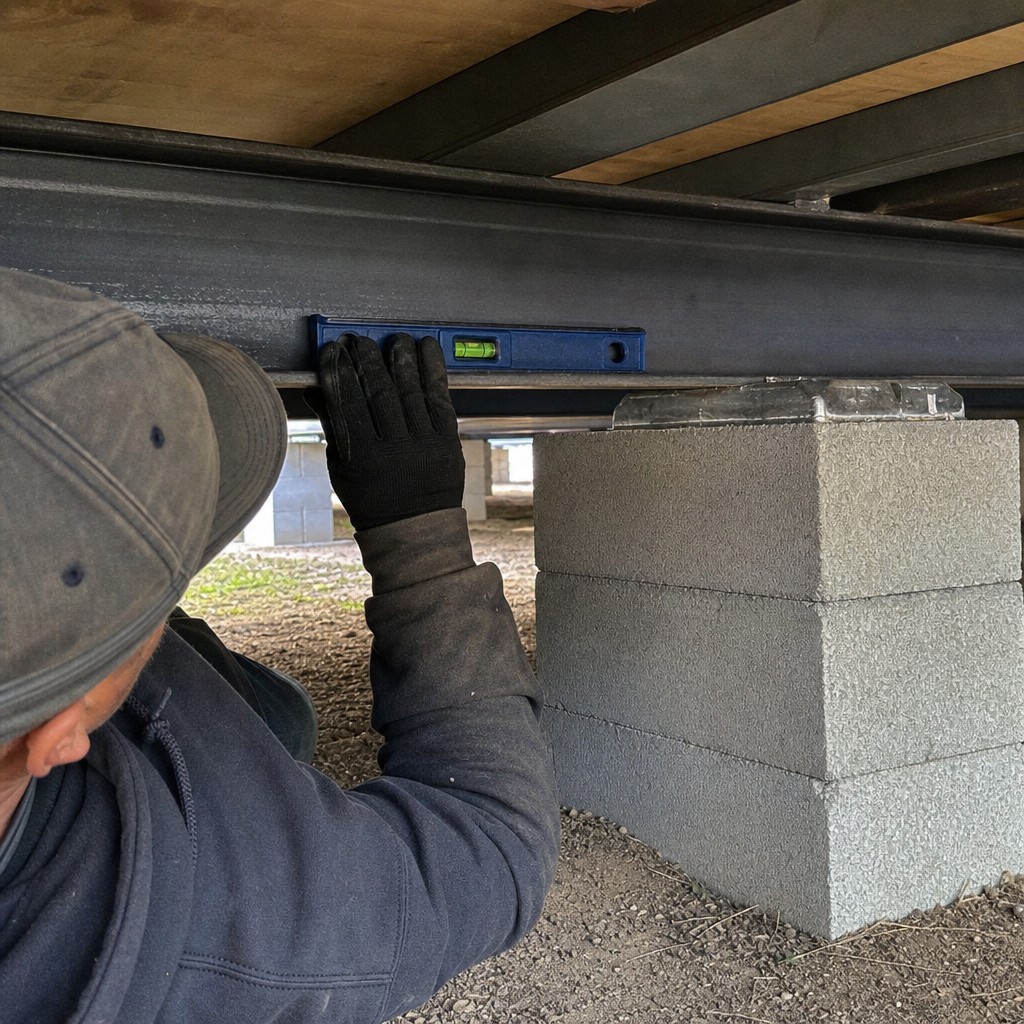
Mobile home leveling, releveling in the trade, is the job of bringing a settled manufactured home’s steel chassis back to flat and evenly supported. Our crew maps every pier with a water level, lifts the low sections on hydraulic jacks carried by cribbing, rebuilds each dropped pier with fresh hardwood shims, and re-shoots the whole frame to prove it. We do that work across Sebring and Highlands County. A singlewide relevel runs $450 to $800, a doublewide $750 to $1,400, and the level check that tells you where your home stands is free.
On the sand under Sebring, this is the most common mobile home problem, and the one most homeowners put off longest. Here is what it actually involves and why it comes around every few years.
Why the ground under Sebring moves
Sebring sits at 98 feet on the southern reach of the Lake Wales Ridge, a line of relic dunes and old islands that runs about 100 miles down the center of the peninsula. The NRCS soil series that dominate it, Astatula, Candler, and Tavares, are among the best-drained soils in Florida, which is good for citrus and bad for pier footings. Astatula’s type location is in Highlands County, half a mile south of where US 27 meets State Road 17, and the official description calls it “excessively drained” sand to more than 80 inches with “very rapid permeability” and no saturation within 60 inches. Candler’s water table is deeper than 80 inches. Tavares, on the lower knolls, is “moderately well drained” with a seasonal water table 42 to 72 inches down.
None of that ground holds a point load well. A manufactured home puts a few thousand pounds on each pier through a footing about a foot or two square. Loose single-grain sand under that footing rearranges itself every time water moves through it, which in Highlands County happens most afternoons from June to September. The NOAA 1991 to 2020 normals for Avon Park 2 W, ten miles up US 27, put 31.66 of the year’s 52.68 inches in those four months. The side of the home under a roof valley, a downspout, or the north shade that never dries drops faster than the side in the sun. Differential settling is what racks the frame, and a racked frame is what you feel in the doors.
East of the ridge the problem changes rather than disappears. The flatwoods toward Lorida and Lake Istokpoga are mapped in poorly drained series with a water table within 18 inches of the surface for months at a time, and homes there sink into saturated soil rather than settling into dry sand. Either way the relevel is the same procedure. The footing fix underneath it is not, which is why the survey matters.
Signs it is time
- Doors that rub at the top corner, then drag, then will not latch.
- Windows that bind in their tracks.
- A slope you feel walking down the hall, or a floor that bounces in one room.
- Cracks opening at wall and ceiling joints, usually above doorways.
- A gap along the marriage line of a doublewide, at the ceiling or the floor.
- Skirting that has buckled or pulled away as the home came down onto it.
- Anchor straps you can flex by hand.
One of those is enough for a free level check. Two or three means the home has been settling for a while.
How the relevel is done
Inspect and map. Skirting access panels come off. Our crew crawls the full length of both I-beams and shoots every pier with a water level off a datum pier, usually the most stable one. Each reading is written on a frame map: this pier a quarter inch low, that one an inch and a half, the marriage-line row three quarters. While under there they handle every pad, cap, and shim stack for crush and rot, check the underbelly for tears, and check every anchor strap for tension and corrosion. The map is what the quote is built from, and you get a copy.
Set up the lift. Twenty-ton hydraulic bottle jacks go on solid wood cribbing at the frame near each low pier. Several stations are set at once. Our crew never works under a home held only by a jack; the cribbing carries the load at every step. That rule is what separates a licensed installer from a handyman with a jack, and it is the reason Florida licenses this trade.
Lift in small increments. The frame comes up a fraction at a time, station to station, so the chassis returns toward plane as a unit. Cranking one point far out of plane is what cracks drywall, pops trim, and on a doublewide tears the marriage-line seal. A door that has stuck for years will often swing free somewhere in the middle of the afternoon.
Rebuild the piers. Under each raised section, blocks are re-stacked or replaced with the hollow cells vertical and each course crossed at right angles, per 24 CFR 3285.304. Crushed caps come out and solid ones go in; the standard calls for solid concrete or masonry at least four inches nominal, or hardwood at least two inches. Hardwood shims are driven tight in opposing pairs between cap and beam. The standard limits shims to one inch of vertical height and hardwood plates to two inches nominal. A pier that cannot reach the beam inside that allowance is rebuilt at the correct height, never stacked with scrap. That is pier and pad work, priced per pier and shown on the quote.
Verify. The entire frame is re-shot with the water level. Every pier has to be carrying load, which is checked by hand; a pier you can rattle is carrying nothing, and a home can read level while standing on piers that do nothing. On a doublewide our crew confirms the marriage line has closed and both halves read matched down the center row.
Re-secure. Anchor straps get re-tensioned, because raising the home changes the tension they were set at. The skirting goes back on. If the survey found a torn belly, a corroded anchor, or a strap system built to the pre-1994 standard, it is on the quote as a separate line, not folded into the relevel.
Singlewide, doublewide, and the marriage line
A singlewide carries its weight on two I-beams and 16 to 24 piers, and a relevel is a three to five hour job. A doublewide has the two outer beams plus a row of piers down the marriage line where the halves meet, and it takes six to eight hours because that center row has to come back to exactly matched height or the seam stays open. The 55+ communities around Sebring, Tanglewood, Buttonwood Bay, Sebring Village, and the rest, are heavy on doublewides, which is why the marriage-line gap at the ceiling is one of the most common complaints in those parks.
What it costs
| Home | Range |
|---|---|
| Singlewide | $450 to $800 |
| Doublewide | $750 to $1,400 |
| Pier reset or reshim, when needed | $75 to $150 per pier |
| Pier rebuild, when needed | $150 to $400 per pier |
The relevel price includes the survey, the lift, new shims, cap replacement where needed, the full re-shoot, and strap re-tensioning. What moves it inside the range is how far the home dropped, how many piers need attention, and the working room under the frame. The pricing page walks through each factor.
Licensed work, and why it is not optional here
Section 320.8249 of the Florida Statutes puts mobile home installers under FLHSMV licensing, and the department’s FAQ states that “only licensed mobile home installers set up a home in Florida.” Setup, defined at section 320.822, is the site work that makes a home fit to live in: positioning, blocking, leveling, anchoring. A licensee posts a bond, carries liability insurance, completes a training course, and passes an exam. Ask for that license before anyone jacks your home. The too-tall shim stacks, scrap-lumber caps, and rattling piers that turn up under homes in the older parks are the fingerprints of the other kind of job.
The honest part
A relevel on this sand is periodic maintenance. Expect it again in three to five years. What lengthens the interval is what happens to water around the home: gutters that carry roof water past the piers instead of onto them, a pad graded so the south side does not stay wet, skirting vents that let the underside dry. Our crew will point out the downspout dumping on your piers while they are under there. Whether you fix it is up to you, but it is cheaper than the next relevel coming early.
We cover Sebring and all of Highlands County, including Avon Park and Lake Placid, plus Frostproof and Wauchula across the county lines. If the doors have started to stick, request the free level check. Our crew shoots every pier and writes the price at the home, and if the survey says the home can honestly wait a season, that is what you will hear.
Frequently Asked Questions
How much does it cost to relevel a mobile home in Sebring?
Singlewides run $450 to $800 and doublewides $750 to $1,400 across Highlands County. The number depends on how far the home dropped, how many piers need rebuilding instead of reshimming, and how much room there is under the frame. The survey is free and the price is written before any jack goes under the beam.
How do you know which piers dropped?
A water level. Our crew picks the most stable pier as a datum and reads every other pier against it, so each one gets a number, not an opinion. The readings go on a frame map that shows exactly where the home is low and by how much, and the quote comes from that map.
Will it need doing again?
On Lake Wales Ridge sand, yes, every three to five years is normal. Loose sand rearranges under a pier footing every time water moves through it, and 60 percent of the year's rain falls in June through September. Correcting drainage and pad problems under the home lengthens the interval; nothing makes it permanent, and anyone who says otherwise is selling.
Can I stay in the house while it is leveled?
Yes. The lifts are small and gradual, and our crew works from outside and under the home. You will hear the frame creak as it comes back to plane and may see a door that has stuck for years swing free partway through the day.
What if a pier is too low to shim?
It gets rebuilt. The federal installation standard at 24 CFR 3285.304 allows shims to take up one inch of vertical height and hardwood plates two inches nominal. A pier that has dropped past that gets a new footing, new blocks, and a new cap at the right height, priced at $150 to $400 per pier and called out on the quote before it is done.
More mobilehome services
- Mobile Home Pier & Pad Repair in Sebring, FL
- Mobile Home Tie-Downs & Anchors in Sebring, FL
- Mobile Home Vapor Barrier Replacement in Sebring, FL
- Mobile Home Skirting Repair in Sebring, FL
- Pre-Sale Mobile Home Leveling Inspection in Sebring, FL
- Mobile Home Transport & Setup in Sebring & Highlands County
- Mobile Home Roof-Over and Roof Coating in Sebring