 Sebring Mobile Home Leveling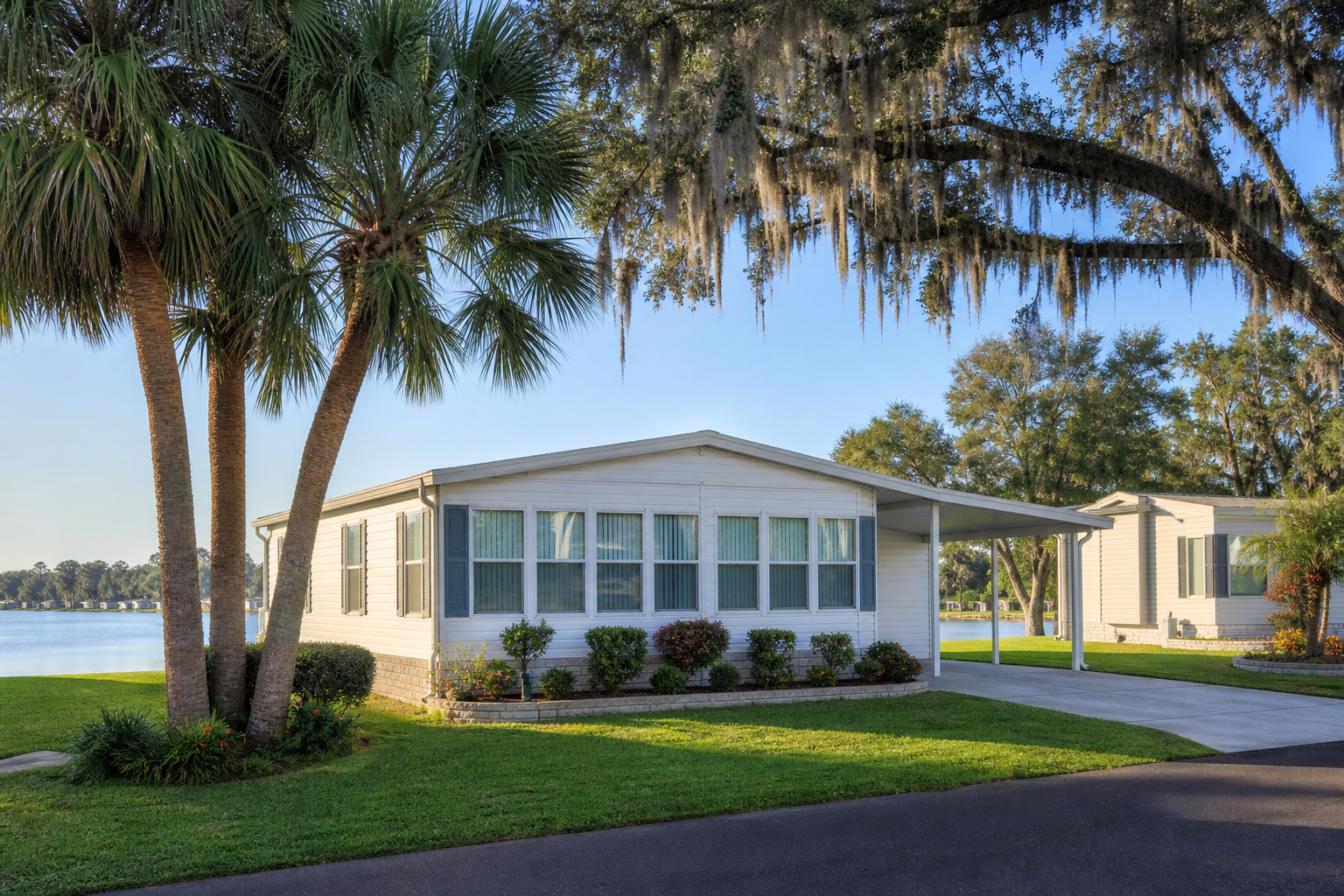
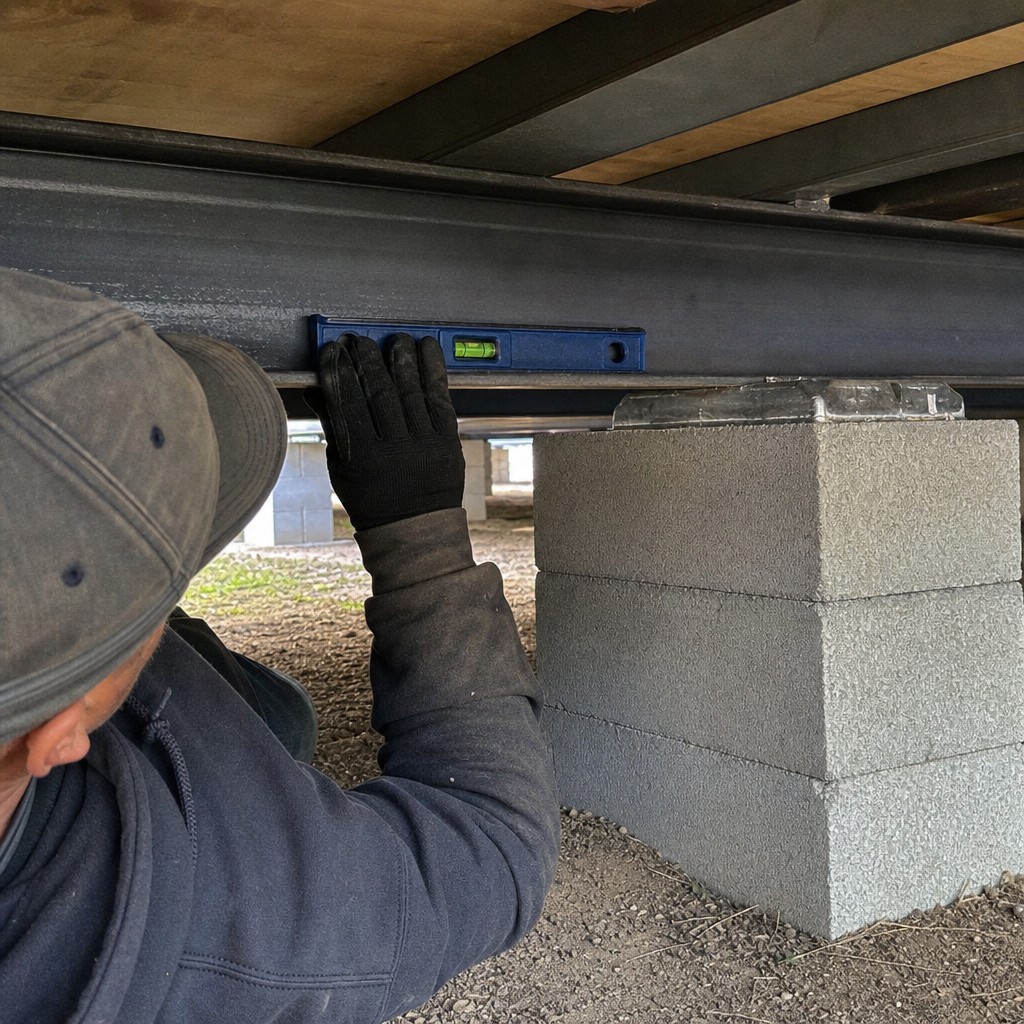
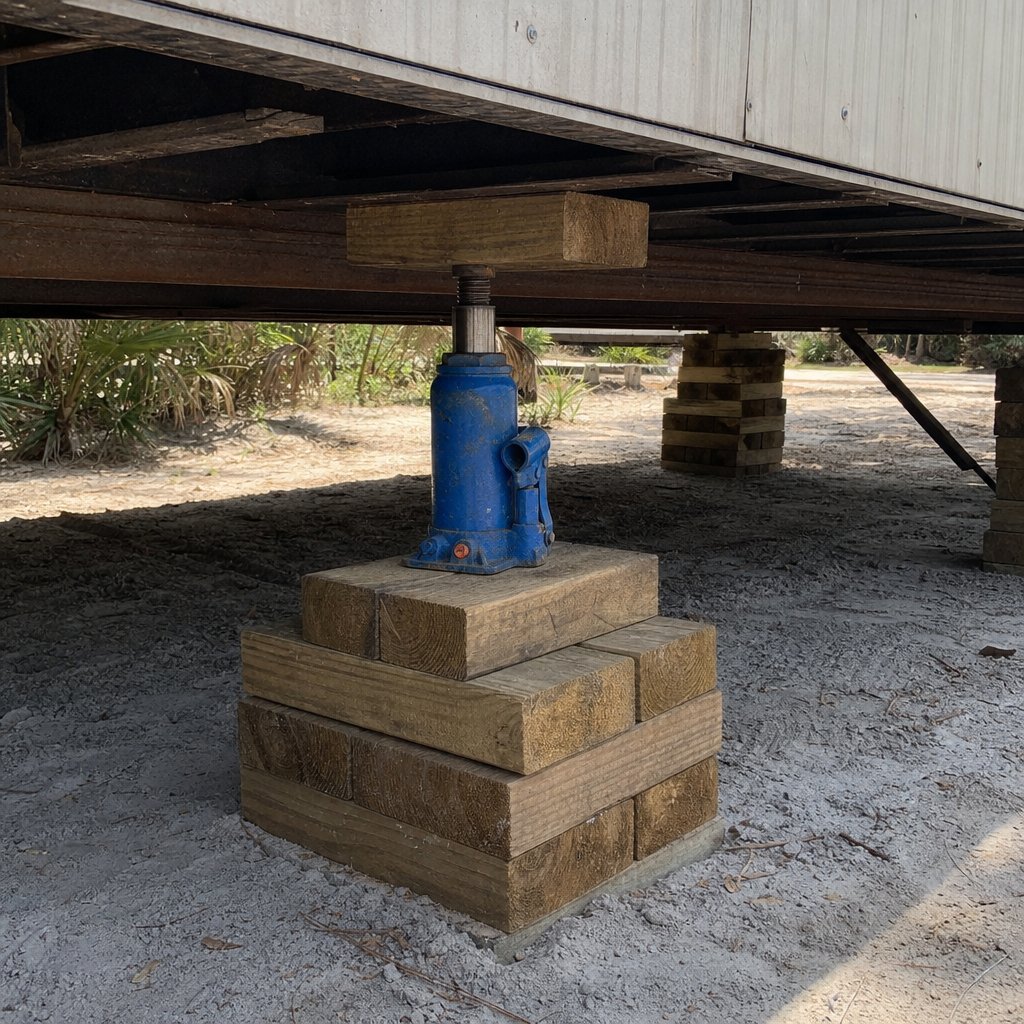
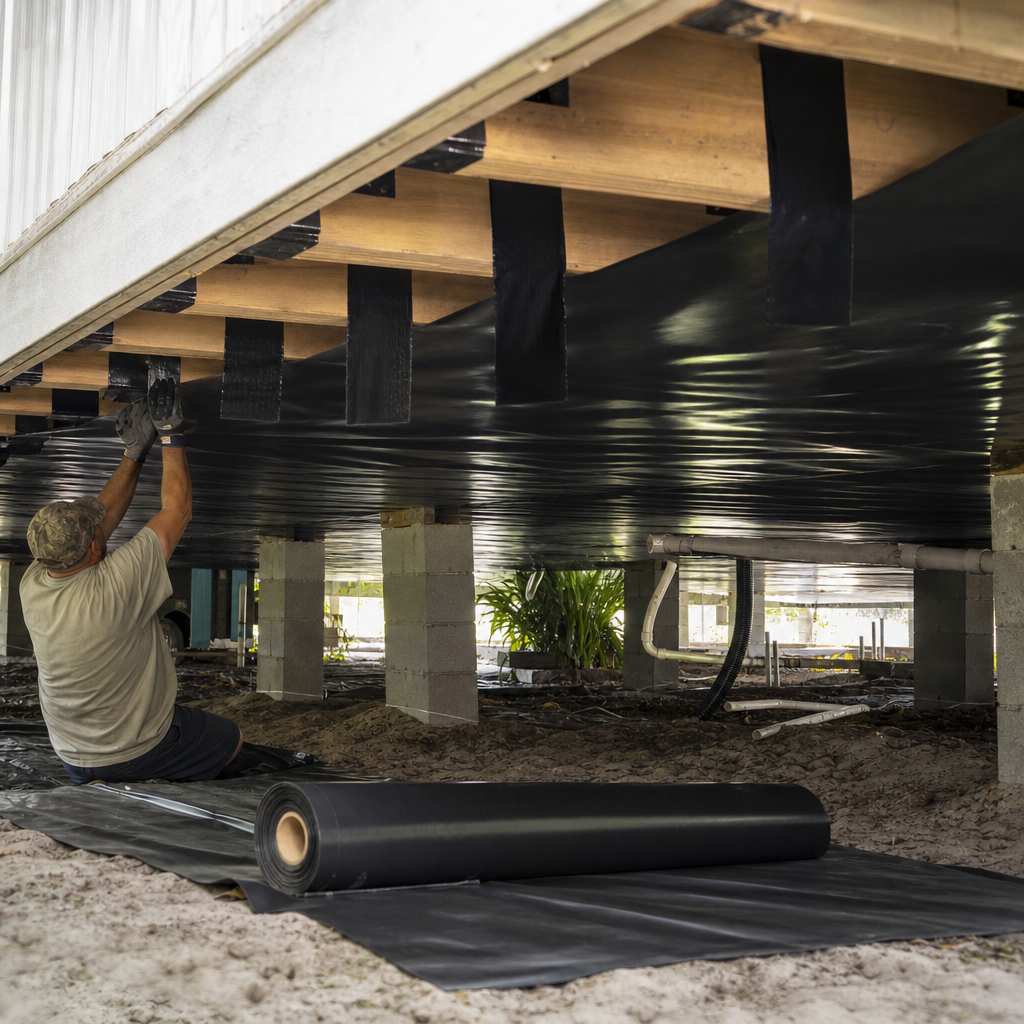
Sebring Mobile Home Leveling brings settled manufactured homes across Highlands County back to level. On every job we shoot every pier with a water level, bring the frame up on hydraulic jacks carried by solid cribbing, and rebuild each low pier with fresh hardwood shims until the whole chassis reads flat again. Our relevels run $450 to $800 on a singlewide and $750 to $1,400 on a doublewide. The survey that maps what your home needs is free.
Sticking doors, a hallway with a lean in it, a ceiling seam that has opened on a doublewide: those are the reasons people call, and around here they all trace back to the same two things, the sand and the rain.
The ridge is the reason
Highlands County is manufactured-home country in a way most of Florida is not. The Florida Department of Health’s housing indicator, drawn from the Census Bureau’s American Community Survey, puts 24.2 percent of Highlands County housing units as mobile homes in 2024, against 8.0 percent statewide. Add the Census Bureau’s figure that 36.2 percent of county residents are 65 or older and a median age of 54, and you have the picture: retirees and snowbirds in 55+ communities like Tanglewood, Buttonwood Bay, Lakeview Mobile Village, and Sebring Village, working families in the parks along US 27 and Sparta Road, and owned-land homes out toward Lorida. Nearly all of it stands on block piers.
The piers stand on the Lake Wales Ridge, or just off it. The ridge is a line of relic sand dunes and old islands roughly 100 miles long that runs down the spine of Polk and Highlands counties, the ground that was above water when most of Florida was not. Its soils are what the USDA Natural Resources Conservation Service calls Astatula, Candler, and Tavares, and the official series descriptions read like a warning label for pier footings. Astatula, whose type location is in Highlands County half a mile south of the US 27 and State Road 17 intersection, is “excessively drained” sand “more than 80 inches” deep with “very rapid permeability” and no saturation within 60 inches of the surface. Candler is the same story, excessively drained sand with the water table deeper than 80 inches. Tavares is the moderately well drained cousin on the lower knolls, with a seasonal water table 42 to 72 inches down.
Dry, deep, loose sand sounds like good ground until you concentrate a few thousand pounds on a footing the size of a doormat. Loose single-grain sand rearranges itself under a point load, and every time water moves through it, which is every afternoon in summer, the grains settle a little tighter and the pier drops a little lower. The wet side of a home, under a roof valley or a downspout, drops faster than the dry side. That difference is what racks the frame, and the frame is what your doors, windows, and floors hang off of.
Come down off the ridge toward Lake Istokpoga and Lorida and the ground flips. The flatwoods soils NRCS maps across this part of the peninsula, Myakka and Immokalee among them, are “poorly drained” with a water table within 18 inches of the surface for one to four months a year. Around the lake margins and depressions you get Basinger, ponded six to nine months of the year, and organic mucks like Samsula, whose water table sits “at or above surface of the soil except during extended dry periods.” Lake Istokpoga itself is Florida’s fifth-largest lake at 26,763 acres and averages four feet deep, ringed by muck that boaters get stuck in. A home on that ground does not sink from compaction so much as from bearing failure in saturated soil, and it settles in a wetter, more uneven pattern than a ridge home.
Then it rains. The NOAA 1991 to 2020 climate normals for the Avon Park 2 W station put annual precipitation at 52.68 inches, of which 31.66 inches, 60 percent, falls in June through September. June alone normals at 9.24 inches. At Archbold Biological Station south of Lake Placid the split is the same, 32.85 of 54.23 inches in those four months. Sixty percent of the year’s water arrives in a third of the year, onto loose sand or onto flats that are already full.
So on ridge sand a relevel is upkeep you schedule, not a one-time fix. Homes on this ground generally need releveling every three to five years. That is not a sales line. It is why this business exists.
What settling looks like from inside the house
You rarely notice it from the yard. You notice it living in it.
- Doors rub, then drag, then stop latching. The opening is no longer a rectangle.
- Windows bind in their tracks, and sometimes crack at a corner.
- Floors slope or bounce. Set a marble on the hallway floor. When it rolls off on its own, the lean is real.
- Cracks open at wall and ceiling joints, usually above doorways where the racking concentrates.
- A doublewide’s marriage line opens. The seam down the center separates at the ceiling or floor because the two halves are no longer at matched height.
- Skirting bows or pulls away as the home descends onto panels that were never meant to carry weight.
Any one of those earns a free level check. Settling compounds: a pier that is an inch low today is grinding its own cap and shims, and it will be lower after next summer. Caught early it is a straightforward relevel. Left a few more seasons it becomes pier rebuilds, and the difference on the invoice is measured in hundreds of dollars.
What a relevel involves
The survey. Access panels off, our crew under the home end to end, every pier shot with a water level off a datum pier. What you get back is a reading for each pier, not a guess. Pads, caps, and shims get handled, the belly gets checked, and every anchor strap gets looked at for tension and rust. We write your price from those readings, and nothing gets lifted until you have it.
The lift. Twenty-ton bottle jacks on solid wood cribbing at the frame near each low pier, working in small increments across several stations so the chassis comes back toward plane as a unit. On our jobs the jack only lifts; the cribbing holds the weight, and that one rule is the line between careful work and dangerous work.
The pier work. Blocks re-stacked or replaced with the hollow cells vertical and each course turned at right angles to the one below, the way the federal installation standard at 24 CFR 3285.304 requires. Crushed caps and pads swapped out. Hardwood shims driven tight in opposing pairs. That same standard caps shims at one inch of vertical height and hardwood plates at two inches nominal, so a pier that cannot reach the beam inside that allowance gets rebuilt at the right height instead of stacked taller. That is priced separately and openly.
The verification. We shoot the whole frame again, front to back. Every pier has to be carrying load, which you confirm by hand, because a home can read level while standing on piers that are doing nothing. With a doublewide, the two halves must come out even with each other along the center row of piers.
The straps. Lifting a home slackens or loads its anchor straps unevenly, so we re-tension every one before we leave. If the anchor system is short, corroded, or built to the pre-1994 standard, you get told and it gets quoted separately rather than quietly added.
Every service we offer
- Mobile home leveling. The core service: we survey, lift, reshim, and re-shoot the full frame, and most homes are finished in a day.
- Pier and pad repair. Sunken block piers and the pads beneath them, reset or rebuilt from the footing up. Resetting runs $75 to $150 per pier and a rebuild runs $150 to $400.
- Tie-downs and anchors. Install, replace, and re-tension ground anchors and straps to Florida Rule 15C-1 in HUD Wind Zone II, which is where 24 CFR 3280.305 places Highlands County.
- Vapor barrier replacement. Repair or replace the sealed underbelly that keeps ground moisture out of your insulation and subfloor.
- Skirting repair. Panels, vents, and access doors, including the storm damage that arrives most summers.
- Pre-sale leveling inspection. A written level, support, and anchoring report for parks, lenders, insurers, and buyers. It costs $150 to $350, and that fee usually comes off the bill for any repair the report turns up.
- Mobile home transport and setup. Full pull-and-set with the county permit package handled, itemized from a site visit.
Our rates, in print
Most outfits in this trade keep their numbers to themselves until they are standing in your yard. The ranges below have been on this website since it went up.
| Service | Typical range |
|---|---|
| Relevel, singlewide | $450 to $800 |
| Relevel, doublewide | $750 to $1,400 |
| Pier reset or reshim | $75 to $150 per pier |
| Pier rebuild | $150 to $400 per pier |
| Anchors and tie-downs | $600 to $3,500 |
| Vapor barrier | $300 to $800 patch, $1,200 to $4,500 full |
| Skirting | $200 to $800 repair, $900 to $2,500 full |
| Pre-sale inspection | $150 to $350 |
| Transport and setup | Itemized from a site visit |
Every leveling job starts with the free survey and ends with a firm written number. Against what deferral costs, leveling stays the affordable end of structural work: a few hundred dollars on a normal cycle instead of the pier rebuilds, rotted subfloor, and racked door frames that pile up when settling runs unwatched for a decade. The pricing page covers what pushes a job inside its range.
Wind Zone II, three hurricanes, and the 1994 line
For a site-built house, wind resistance is built into the structure. For a manufactured home it is almost entirely the anchoring system, and that system degrades without announcing itself.
Highlands County has had the center of a hurricane pass over or beside it three times in twenty years. Charley on August 13, 2004 came ashore near Cayo Costa as a Category 4 and, in the words of the National Weather Service Tampa Bay summary, “moved through Fort Ogden, Arcadia, Zolfo Springs, and Wauchula” at about 25 mph, “right up US 17,” with “several manufactured home, mobile home, and RV communities heavily damaged or destroyed between Arcadia and Wauchula.” Sebring sat 25 miles east of that track; a radio tower near town went down and Archbold gusted to 49 knots. Irma on the night of September 10, 2017 tracked up through Hardee and Polk as a Category 2 fading to Category 1, with a wind field so wide that the Sebring FAWN station logged a 49-knot reading and the Sebring 4.7 WNW gauge caught 10.54 inches of rain. Ian on September 28, 2022 was the direct hit. The National Hurricane Center’s best track has the center at 27.2N 81.7W with 100-knot winds at 0000 UTC on the 29th and at 27.7N 81.1W six hours later; the line between those points runs straight across Highlands County through Sebring. Sebring Regional Airport gusted to 78 mph, about 89 percent of the county lost power, and a brief tornado touched down in Lake Placid.
None of that is why the anchors matter most. The 1994 line is. Florida Rule 15C-1.0104 specifies two anchor classes: Type I, tested to a 3,150-pound working load, for homes manufactured before July 13, 1994, and Type II, tested to 4,000 pounds, for homes built after. That date is when HUD’s post-Andrew wind standard took effect, and a large share of the park stock around Sebring, Avon Park, and Lake Placid predates it. Straps go slack every time the home settles, which on this ground is continuously, and anchor shafts corrode below grade where nobody looks. That is why tie-down work and leveling are one conversation here rather than two, and why straps are re-tensioned as part of every relevel.
Who is allowed to do this work
Florida is specific about it. Section 320.8249 of the Florida Statutes puts mobile home installer licensing under the Department of Highway Safety and Motor Vehicles, and the department’s own FAQ says it plainly: “Section 320.8249, Florida Statutes and Rule 15C-2, F.A.C. require that only licensed mobile home installers set up a home in Florida.” Asked whether a homeowner can do it, the department’s answer is “No.” Setup, under section 320.822, is “the operations performed at the occupancy site which render a mobile home or park trailer fit for habitation,” which is what blocking, leveling, and anchoring are. Installing without a license is a first-degree misdemeanor.
A licensee posts a performance bond, carries liability insurance, completes a department-approved training course, passes an exam, and renews every year. Highlands County adds its own layer: a mobile home permit application “must be submitted with the penetrometer test, tie down/blocking/anchoring schedule,” a used home needs a $54 pre-move inspection before a setup permit is issued, and the county worksheet states in capitals that “ALL TESTS MUST BE PERFORMED BY A LICENSED INSTALLER.”
This is spelled out here because it protects you. Ask every bidder for a Florida installer license number and proof of insurance and pay attention to who gets quiet.
Where the service area runs
Coverage runs out of Sebring along US 27 and US 98. Avon Park is ten miles north, the oldest city in the county and home to Reflections on Silver Lake, Crystal Lake Club, and Highlands Ridge. Lake Placid is sixteen miles south, with Tropical Harbor, Paradise Village, and the lake-margin homes toward Istokpoga. Lorida is out US 98 on the north shore of the lake. Over the county lines, Frostproof sits on the Polk County end of the ridge and Wauchula is the Hardee County seat down SR 66 and US 17.
Book the free level check
Call or write with whatever has changed in the house, a door that will not close, a hallway with a lean, a seam that has opened, along with the home’s size and where it sits. We come out, shoot every pier, and write the price at the home while the readings are fresh. You get a pier-by-pier map, a firm number, and a straight answer about what needs doing now versus what can honestly wait. Questions first? The FAQ covers most of them, or read how we work.