 Sebring Mobile Home Leveling
 Mobile Home Pier & Pad Repair in Sebring, FL
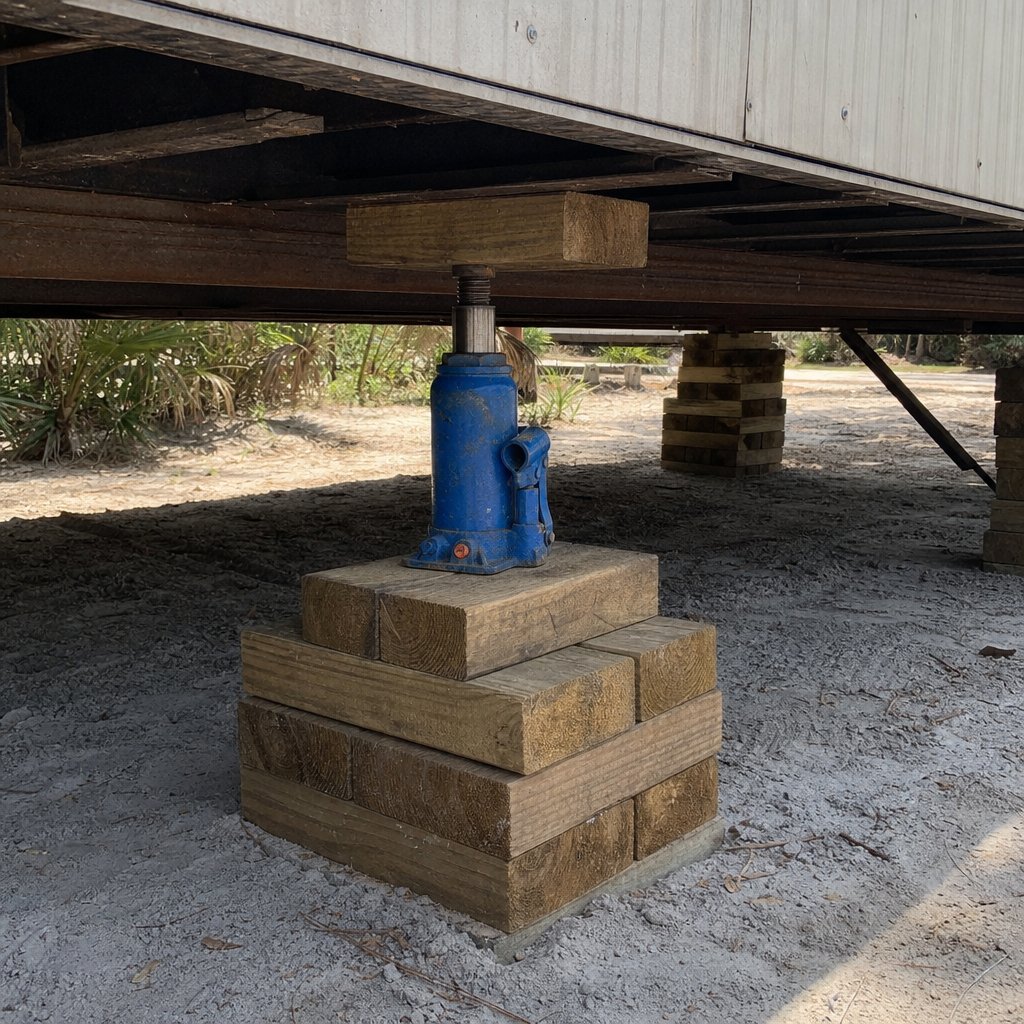
Pier and pad repair is the work under the work. A manufactured home stands on a few dozen stacks of concrete block, each one sitting on a footing pad pressed into the ground, each one topped by a cap and a pair of hardwood shims that meet the steel I-beam. When a pad sinks, a block cracks, a cap crushes, or a shim stack rots, that pier stops carrying its share and the frame above it drops. Pier resets and full pier rebuilds across Sebring and Highlands County are work our crew does. Resets run $75 to $150 per pier and rebuilds $150 to $400, with the survey that counts them free.
Every relevel touches piers. This page is about the ones that need more than a shim.
What a pier is supposed to be
The federal installation standard at 24 CFR Part 3285 lays out the pier in plain terms. Concrete blocks are stacked with their hollow cells vertical and each course turned at right angles to the one below. On top goes a cap, “solid concrete or masonry at least 4 inches in nominal thickness, or hardwood lumber at least 2 inches nominal in thickness,” the same length and width as the pier. Then shims, nominal 4 by 6 by 1 inch, “used in pairs” and “driven in tightly so that they do not occupy more than one inch of vertical height.” Hardwood plates no thicker than two inches nominal, or two-inch or four-inch solid block, fill any remaining gap. Under all of it is a footing pad sized to the soil’s bearing capacity.
That is the whole system, and every part of it fails in a specific way on Highlands County ground.
How piers fail here
The pad sinks. This is the ridge failure. Astatula and Candler sands under Sebring and Avon Park are excessively drained, loose, single-grain sand to more than 80 inches deep. A pad that is too small for the load, which is most pads on older homes, presses a few thousand pounds into a footprint the size of a doormat, and every summer storm that pushes water through the sand lets the grains under it settle tighter. The pier goes down a little each year. The pier next to it, under a drier stretch of ground, does not. The beam between them twists.
The pad sinks faster and wetter. This is the flatwoods failure, on the lower ground toward Lake Istokpoga, Lorida, and the lake-margin lots south of Lake Placid. Myakka and Immokalee soils carry a water table within 18 inches of the surface for one to four months a year; Basinger is ponded six to nine months; Samsula muck has water “at or above surface” most of the year. Saturated sand and muck do not compact, they yield. A pad on that ground can drop an inch in a single wet season, and it drops unevenly, so the frame does not just tilt, it warps.
The cap crushes. A cap that is undersized, split, or made of soft scrap lumber crushes under the beam. When the cap goes, the shims go with it, and the beam ends up resting on the top course of block, which was never meant to take a point load without a cap. Broken top blocks under caps that gave up years ago are a common result.
The shims rot or over-stack. Shims are supposed to be hardwood and one inch total. Under older homes, the usual failures are pine shims that have rotted to sponge and stacks three and four inches tall. An over-stacked pier is unstable side to side, which matters when a Wind Zone II gust is pushing the home sideways against its anchors.
The block cracks. Freeze is not the problem in Sebring. Overload is. A pier carrying the load of two failed neighbors cracks its blocks, and a cracked block in a single-stack pier is a pier that is done.
The survey decides reset or rebuild
The free level check that starts every leveling job is also the pier survey. Our crew shoots each pier with a water level, but they also put hands on each one: rock the stack, check the cap for crush, count and measure the shims, look at the pad. Each pier gets a verdict.
Reset, $75 to $150. The stack is sound and plumb, the pad has not moved, and the gap to the beam is inside the shim allowance. The pier gets a new cap if needed and fresh hardwood shims driven tight in pairs. This is what most piers on a routine relevel get, and it is what the relevel price includes for the piers it covers.
Rebuild, $150 to $400. The pad has sunk, the blocks have cracked, the stack is leaning, or the gap is larger than one inch of shim plus two inches of plate can honestly fill. The stack comes apart. The footing is re-cut and, where the soil calls for it, enlarged. New blocks go up with cells vertical and courses crossed, a new solid cap goes on, and the pier is shimmed to the beam at the correct height. On a doublewide the marriage-line piers get the same treatment, because that row is what holds the seam closed.
The count is the whole price. A singlewide has 16 to 24 piers; a doublewide adds the center row. A home leveled every four years usually needs two to five rebuilds at most. A home that has gone ten years on a wet lot might need half its piers rebuilt, and that is when the pier work costs more than the relevel. You see it on the quote, pier by pier.
Pads, and why bigger beats taller
Highlands County’s mobile home permit worksheet has a table that interpolates from Florida Rule 15C-1: for a given soil bearing capacity, tested with a pocket penetrometer at six locations at footer depth and rounded down in 500-pound increments, the allowed pier spacing depends on footer size, from a 16 by 16 inch pad at 256 square inches up to 26 by 26 at 676. The county lets an installer declare 1,000-pound soil without testing, which is the conservative floor. The lesson in that table applies to every rebuild: on soft ground you spread the load, you do not stack it higher. A pier that sank on a 16-inch pad gets rebuilt on a bigger one. That is why a rebuild costs more than a reset, and why it stays put.
Pricing
| Work | Range |
|---|---|
| Reset or reshim | $75 to $150 per pier |
| Rebuild (new pad, blocks, cap, shims) | $150 to $400 per pier |
| Typical whole-home pier job | $500 to $2,500 |
Pier work is almost always done as part of a relevel, and the pricing page shows how the two combine. If a home only needs a couple of piers rebuilt and the rest is fine, we will say so.
Licensed, because the county checks
Every one of those steps is installation work under section 320.8249 of the Florida Statutes, which must be performed by licensed installers, and the county’s worksheet says in capital letters that “ALL TESTS MUST BE PERFORMED BY A LICENSED INSTALLER.” Ask whoever does the work for the license number before any pier comes apart, and check it with FLHSMV.
If a corner of the home has dropped, a door has gone from sticking to not closing, or you have looked under the skirting and seen a stack that leans, request the free level check. Requests are taken from Sebring, Avon Park, Lake Placid, Lorida, Frostproof, and Wauchula, and the pier-by-pier map comes with the price.
Frequently Asked Questions
What does pier repair cost in Highlands County?
Resetting or reshimming an existing pier runs $75 to $150. Rebuilding a pier with a new footing pad, new blocks, and a new cap runs $150 to $400. Most whole-home pier jobs land between $500 and $2,500 depending on how many piers the survey finds low, crushed, or sunk.
What is the difference between a reset and a rebuild?
A reset keeps the existing block stack, which is sound, and brings the pier back to the beam with a new cap and fresh shims. A rebuild takes the stack apart because the pad has sunk, the blocks have cracked, or the gap to the beam is bigger than the federal shim limit allows, and builds it back on a proper footing at the right height.
Why do piers sink into sand that drains so well?
Because drainage is not bearing. Astatula and Candler sands on the ridge are loose and single-grain to more than 80 inches deep, and loose sand rearranges under a concentrated load every time water moves through it. A pier on a small pad presses a few thousand pounds into a footprint about the size of a doormat, and the sand under it gives a little with every summer storm.
Do you rebuild piers on lakeside lots differently?
Yes. On the flatwoods and lake-margin ground toward Istokpoga and Lorida the water table sits inches down for months, so the fix for a sinking pier is usually a larger footing pad that spreads the load, not a taller stack. Highlands County's own worksheet ties allowed pier spacing to footer size and tested soil bearing, and a bigger pad is often the difference between a pier that holds and one that sinks again next summer.
More mobilehome services
- Mobile Home Leveling in Sebring, FL
- Mobile Home Tie-Downs & Anchors in Sebring, FL
- Mobile Home Vapor Barrier Replacement in Sebring, FL
- Mobile Home Skirting Repair in Sebring, FL
- Pre-Sale Mobile Home Leveling Inspection in Sebring, FL
- Mobile Home Transport & Setup in Sebring & Highlands County
- Mobile Home Roof-Over and Roof Coating in Sebring